Hard water and water softener sizing: what a Yakima homeowner should know
Size a softener to the household, not the showroom: hardness, people and daily use set the answer.
October 7, 2026 · 3 min read
Hard water is water carrying a high load of dissolved minerals, mostly calcium and magnesium. You do not need a lab to suspect it. If you have been scrubbing the same white crust off a showerhead for years, you have seen what it leaves behind. The fix is a water softener, and the part people most often get wrong is choosing the right size.
Signs of hard water in your home
- White scale on faucets and showerheads.
- Spots on dishes and glassware, even after a full wash.
- Soap residue that is difficult to rinse.
- Mineral buildup around fixtures.
- An existing softener that no longer performs.
Hard water can leave white mineral deposits on fixtures, spotting on glass and scale inside water-using equipment. That scale builds up slowly, so many households live with it for years without connecting it to the water. If your home already has a softener and the spots are creeping back, the softener may be the problem, not the water.
How softener sizing works
A softener holds a bed of resin beads that grab hardness minerals as water flows through. Eventually the resin is full. The system then regenerates: it flushes the resin with salt brine, sends the captured minerals to the drain, and starts over. Capacity is how much hardness the resin can hold between regenerations.
CSR Plumbing's guidance is that sizing depends on three things: water hardness, household size and daily water use. Harder water fills the resin faster. More people means more gallons per day. A home with heavy laundry and long showers uses more than one without. A system that is too small may regenerate too often. An oversized system can be inefficient. Bigger is not better. Matched is better.
The first number you need is your water's hardness. It differs from one water source to another, whether city supply or a private well, so test your own water or ask your provider rather than guessing from a neighbor's results.
Where a softener goes
Location decides how much of the house benefits. The second step in CSR's softener process is to confirm the installation location, and the logic is straightforward. A softener belongs where it can treat the water before it branches off to the rest of the house, with the connections it needs close by.
- Near the main water entry, so the whole house is treated.
- Near a drain that can take the regeneration water.
- Within reach of power for the control head.
- With room around it to add salt and to service it.
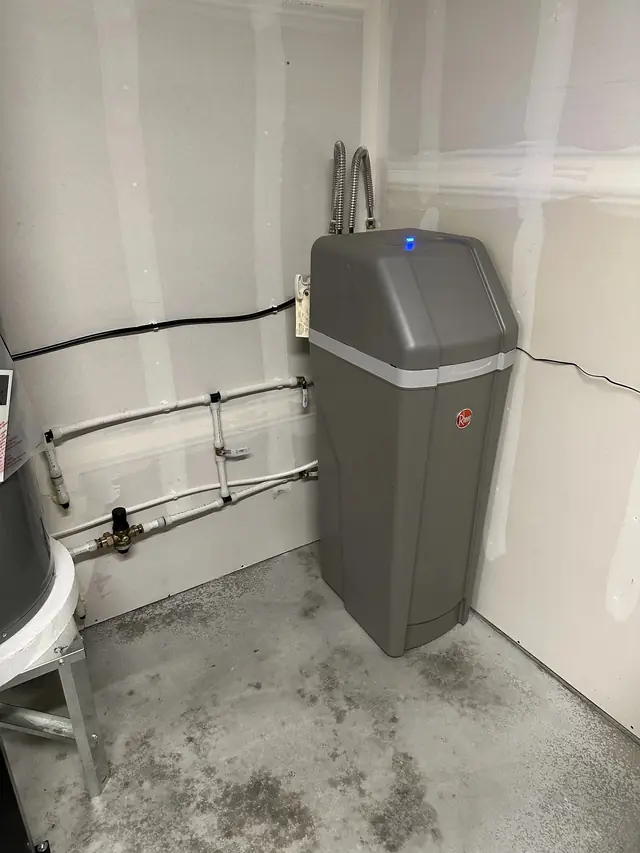
The photo above shows a new Rheem water softener plumbed with PEX loops in a utility room, from CSR's own installation work. Tidy plumbing connections matter here, because a softener is something you will open, refill and service for years.
Salt and everyday care
A softener asks very little of you, but not nothing. The brine tank holds the salt that regeneration depends on, and it needs topping up as the level drops. Check it on a regular schedule rather than waiting for the hard-water signs to return. The third step in CSR's process is to install the system and explain care, so you leave knowing how to handle the salt and what routine maintenance looks like.
Be patient with the results. Softened water prevents new scale from forming, but deposits that are already on your fixtures and inside your equipment tend to loosen gradually rather than disappear overnight.
Replacing an old softener
Softeners do wear out, and some were simply the wrong size for the household that lives with them now. CSR Plumbing handles system selection, installation and replacement, along with the plumbing connections. If your current unit regenerates all the time, or your hard-water signs have come back, describe what you are seeing when you call.
CSR's first step is to review your water and how your household uses it, which is the information sizing depends on. It is easier to get right at the start than to live with a unit that is too small or too large for years.
Talking it over with a Yakima plumber
If you are dealing with scale, spotting or a softener that has stopped working in Yakima or the surrounding valley, call CSR Plumbing at (509) 480-2536. CSR is available Monday through Friday, and calling during weekday business hours is the way to check availability. The office is closed Saturday and Sunday.
CSR Plumbing & Drain Cleaning, (509) 480-2536
Call (509) 480-2536More articles
Several drains backing up at once: what it means for your main sewer line
One slow sink is a local clog, but several fixtures misbehaving together is a different story.
When drain cleaning is not enough and the sewer line needs repair
A cleaning clears the pipe, while a repair fixes the pipe, and knowing which one you need keeps you from repeating the same call.